
In regulated environments, sharing documents often requires balancing transparency with confidentiality — a balance that is frequently misunderstood or poorly controlled in day-to-day practice.
A core tool for doing this is the redacted document — a copy of a record where sensitive information has been obscured or removed before distribution.
For professionals working in Document Control, understanding how to create, review and manage redacted documents is essential. This article explains what redacted documents are, why they matter, and how to handle them correctly without compromising compliance or auditability.
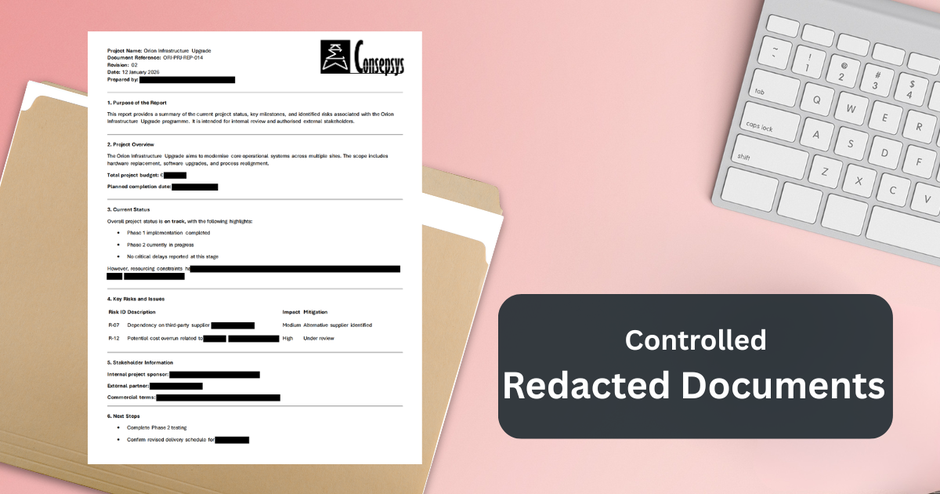
What is a redacted document?
A redacted document is a version of an original record in which specific information has been permanently obscured or deleted to prevent disclosure. This can include:
- Personal data (e.g. names, addresses, identification numbers)
- Commercially sensitive information (e.g. pricing, contract terms)
- Security classifications
- Intellectual property or proprietary formulas
- Legal or regulatory details
- Other sensitive information
Redaction differs from simple masking (e.g. covering text with a black box in a PDF) when the obscured content must be unrecoverable and fully compliant with legal and regulatory requirements.
Why redaction requires formal governance
Although redaction is widely used in legal, regulatory, and information security contexts, it is not yet a well-defined or consistently formalised topic within Document Control practices. In many organisations, redaction is treated as an ad-hoc activity, carried out without clear procedures, ownership, or traceability.
Managing risks
From a Document Control standpoint, this lack of structure represents a real and recurring risk.
When documents are issued externally or to a broader internal audience, redaction becomes a controlled activity that directly affects confidentiality, compliance, and auditability. Document Control must provide the framework needed to manage redacted documents with the same rigour as any other controlled record.
Protecting confidentiality and privacy
Organisations frequently share technical, contractual, or operational documents with third parties such as contractors, auditors, regulators, or partners. Without formal redaction controls, sensitive information can be unintentionally disclosed - often without anyone realising it at the time.
Effective redaction helps protect:
- Personal data subject to privacy legislation (for example, GDPR)
- Commercially sensitive or confidential business information
- Security-classified or restricted content
Failure to manage redaction correctly can result in data breaches, contractual disputes, regulatory sanctions, and long-term reputational damage.
Supporting contractual and regulatory obligations
Many contractual agreements and regulatory frameworks impose strict requirements on how information may be disclosed, shared, or withheld.
Redaction is often the mechanism that enables controlled disclosure while remaining compliant.
Properly governed redaction supports compliance with data protection legislation, information-sharing restrictions and industry-specific confidentiality requirements.
Practical examples of when redaction may be used
The following examples illustrate common situations across different contexts.
Example 1: Defence industry – Controlled technical disclosure
In the defence industry, technical documents such as specifications or maintenance manuals are often shared with subcontractors or external auditors. While access to certain operational information may be necessary, other content may be subject to security classifications or defence regulations.
In these cases, redaction is used to remove classified technical parameters, sensitive system capabilities, or security-related information.
Example 2: Cross-Industry – External sharing of internal reports
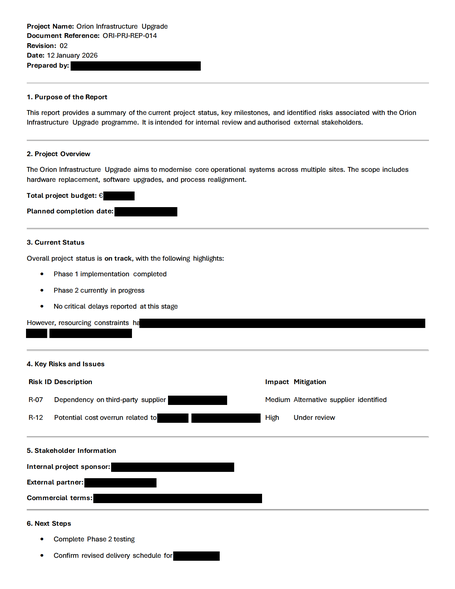
In a more generic scenario, an internal report (such as an incident report or audit summary) may need to be shared with an external stakeholder. While the overall conclusions may be relevant, the document may also contain personal data, internal cost information, or internal commentary not intended for external audiences.
Example 3: Project and Engineering environments – Partial disclosure to stakeholders
In project-based environments (such as engineering, construction, or EPC projects), documents like project plans, schedules, technical reports, or design summaries are often shared with clients, partners, or subcontractors who do not have full visibility of the project.
While these stakeholders may need access to specific information relevant to their scope, the document may also include:
-
Commercial terms or internal cost breakdowns
-
Information relating to other contractors or work packages
-
Internal risk assessments or preliminary design assumptions
In such cases, redaction allows the project team to share the necessary project information without exposing commercially sensitive data or internal assessments.
Who is responsible for redacting documents?
It is important to clarify that Document Control is not responsible for deciding what information should be redacted.
In practice, the physical act of redaction is usually carried out by the document owner or a subject matter expert (SME) who has detailed knowledge of the document content and understands which information is sensitive. In regulated or high-risk environments, redaction may also be performed by legal, compliance, information security, or data protection teams, particularly when documents are being prepared for external disclosure, litigation, or regulatory review.
The role of Document Control is to ensure that redaction is executed within a controlled, documented, and auditable process: verifying that the information to be redacted has been identified, that the redaction has been authorised, that the correct tools and procedures are used, that the redacted document is properly versioned, approved, and distributed, and that full traceability to the source document is maintained.
📋Download our free Checklist for Redacted Documents here 👉LINK
Tools for redacting documents
Document redaction should always be performed using tools that permanently remove underlying content, rather than simply obscuring it visually. Some commonly used tools include:
1️⃣Adobe Acrobat Pro
Many organisations use the redaction functionality within Adobe Acrobat.
Its redaction tool permanently removes selected text, images, and metadata. It is especially common in environments where PDFs are the final issued format.
2️⃣Dedicated Redaction and eDiscovery Tools
In legal, regulatory, or high-volume environments, organisations may use dedicated redaction or eDiscovery platforms.
These tools often support:
- Automated identification of personal or sensitive data
- Batch redaction across large document sets
- Detailed audit logs of redaction actions
- Role-based access and approval workflows
Such tools are commonly used for litigation support, regulatory responses, or freedom-of-information requests, where traceability and scale are critical.
3️⃣Document Management and Information Governance Platforms
Some Electronic Document Management Systems (EDMS) and information governance platforms include built-in redaction or disclosure control features.
⚠️ Software is just a tool
Regardless of the tool used, redaction should never be treated as a purely clerical technical task.
From a Document Control standpoint, the priority is not the software itself, but ensuring that:
- Redaction is authorised by the appropriate role
- The tool used permanently removes sensitive content
- The redacted document is properly versioned and traceable
- Review and approval evidence is retained
How Document Controllers must manage redacted documents
Redacted documents are not new revisions of the original document
From a Document Control perspective, a redacted document must not be treated as a new revision of the original document. This distinction is critical.
A document revision represents a change to the content, meaning, or validity of the original record and typically replaces the previous revision for its intended use. Redaction does not fulfil this purpose. The original document remains valid, complete, and unchanged; it is simply not appropriate for certain audiences.
For this reason, a redacted document must be managed as a separate version or controlled copy, similar in principle to a working copy (work-in-progress) or an external disclosure copy. The difference between revisions and versions is one of the key topics we cover in our Certified Document Controller Course.
Treating it as a revision is not just incorrect — it creates unnecessary confusion during audits and reviews.
Principles for redacted documents
A redacted document:
- Does not supersede the original document
- Does not invalidate or modify the original revision
- Exists solely to support controlled disclosure
However, this does not mean it can be unmanaged and uncontrolled.
From a Document Control standpoint, a redacted document must still:
- Be uniquely identified (file name, suffix, or copy identifier)
- Be linked to the source document in the Document Management System
- Be stored in a controlled location
- Be subject to approval before release
- Have its distribution tracked
📋Practical resource
To support the controlled management of redacted documents, we have prepared a practical checklist for Document Controllers.
⬇️Download the Redaction Checklist
(Word / Google Docs)

Key takeaway
Redacted documents are a critical control point in many regulated and collaborative environments:
- Done correctly, they protect confidentiality, support compliance, and reduce risk
- Done poorly, they can expose organisations to legal and operational vulnerabilities
For Document Control teams, the foundation of effective redaction lies in a clear policy, the right tools, a rigorous approval cycle and robust tracking.