Definition
Document Control is the controlled process by which documents are created, reviewed, approved, distributed, accessed, updated, and maintained throughout their existence.
Its primary purpose is to ensure that the right people can rely on the right documents at the right time — knowing that those documents are current, approved, and traceable.
Document Control is not limited to storing files or organising folders. It governs how documents move through defined stages, from creation to withdrawal, and how changes are managed once a document is in use. This includes ensuring that obsolete revisions are removed from circulation, that approvals are documented, and that access is appropriate to the document’s status and sensitivity.
At its core, Document Control is about trust. A document that is not controlled cannot be assumed to be reliable. Conversely, a controlled document provides confidence: it has been reviewed, approved, and issued through a recognised process, and its status can be demonstrated if required.
For this reason, Document Control is a formal requirement in many quality management systems, including ISO 9001, and is a foundational component of information governance.
It applies across industries, but becomes particularly critical in environments where safety, compliance, contractual obligations, or public accountability are involved.
Document Control is therefore not an administrative task, but a professional discipline that supports governance, accountability, and effective decision-making.
Document Control ensures that documents can be trusted by enforcing controlled processes across their lifecycle.
Prefer a quick overview?
Watch our expert explanation in under 3 minutes.
Why Document Control exists
In professional and regulated environments, decisions are made on the basis of documented information. If that information is inaccurate, outdated, or uncontrolled, the decisions that follow are exposed to risk.
Document Control exists to prevent that risk by establishing formal rules and responsibilities around how documents are handled.
What Document Control covers
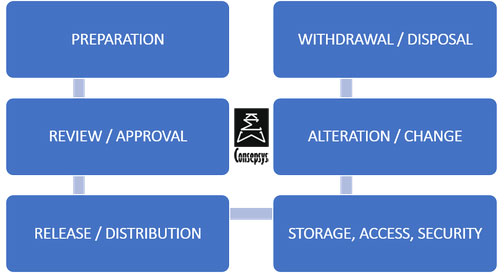
Document Control applies across the full document lifecycle, including:
-
Creation and identification
-
Review and approval
-
Change and revision control
-
Distribution and access management
-
Withdrawal, supersession, or archiving
Each stage is governed by procedures that define who does what, when, and under which conditions.
What Document Control is not
Document Control is often misunderstood.
It is not:
-
Filing or storage.
Storing documents does not ensure they are approved, current, or reliable. -
A software tool.
Systems support Document Control, but they do not replace defined processes, roles, and accountability. -
Records Management.
Document Control governs active documents in use; Records Management governs retained records after use. -
An informal practice.
Naming conventions or shared drives alone do not constitute control without formal procedures.
👉 Document Control is a discipline, not a location, tool, or habit.
Who performs Document Control
Document Control may be carried out by dedicated Document Controllers, Information Management professionals, or trained project staff, depending on the organisation and environment.
Regardless of role or title, effective Document Control requires:
- Defined responsibilities
- Consistent application of procedures
- Organisational support and authority
It is a professional function, not an administrative afterthought.
Document Control and related disciplines
Document Control is often associated with Information Management, Records Management, and Quality Management, but it has a distinct focus.
Document Control operates alongside other information disciplines but serves a specific role:
-
Information Management provides the broader governance framework.
-
Quality Management (e.g. ISO 9001) defines mandatory document control requirements.
-
Records Management governs retention and disposition after documents are no longer active.
-
Knowledge Management focuses on learning and knowledge sharing, not document authority.
Document Control specifically ensures that documents used for work and decisions are accurate, approved, traceable, and trusted at the point of use.
Why governance and training matter
Document Control processes are only effective when they are understood and applied consistently. Informal practices, assumptions, or partial adoption quickly undermine control.
Training and governance provide the structure needed to apply Document Control with confidence, clarity, and authority — particularly in regulated, complex, or high-risk environments.
Document Control and ISO 9001
Document Control is not only a recognised professional practice; it is also a formal requirement of the ISO 9001 international standard for Quality Management Systems.
ISO 9001 requires organisations to establish and maintain documented procedures that define how documents are controlled. The intent of these requirements is to ensure that documented information used within an organisation is reliable, current, and fit for purpose.
Under ISO 9001, Document Control includes the establishment of controls to:
-
approve documents for adequacy prior to issue
-
review and update documents as necessary, and re-approve them
-
ensure that changes and the current revision status of documents are identified
-
ensure that relevant versions of applicable documents are available at points of use
-
ensure that documents remain legible and readily identifiable
-
ensure that documents of external origin are identified and their distribution is controlled
-
prevent the unintended use of obsolete documents, and apply suitable identification to them if they are retained for any purpose
These requirements reflect the core objectives of Document Control: maintaining trust in documented information, ensuring traceability, and supporting consistent and auditable decision-making.
As a result, organisations seeking or holding ISO 9001 certification must implement Document Control as a structured and controlled process, rather than as an informal or ad-hoc activity.
(ISO refers to the International Organization for Standardization).
Operational Impact of Document Control
Document Control has a direct operational impact on how safely, efficiently, and consistently an organisation can work. When documents are not properly controlled, teams lose time searching for information, rework increases, and decisions are made using outdated or unofficial revisions.
Effective Document Control supports day-to-day operations by ensuring that:
-
people can quickly locate the correct, approved information at the point of use
-
changes are reviewed, approved, and traceable (who changed what, when, and why)
-
distribution is controlled so the right audiences receive the right revisions
-
external documents (standards, vendor documentation, client requirements) are identified and managed
-
audits, inspections, and regulatory checks can be supported with clear evidence
-
safety and quality risks are reduced by preventing the unintended use of obsolete documents
In short, Document Control reduces operational friction and risk by making documentation dependable, repeatable, and auditable across the document lifecycle.
Why Document Control Matters Across Organisations
Document Control plays a critical role in enabling organisations to operate efficiently, safely, and consistently.
When documents are not properly controlled, the consequences often include operational delays, compliance risks, quality failures, and loss of trust in information.
Well-implemented Document Control supports:
-
reliable and up-to-date information at points of use
-
traceability of decisions and changes
-
consistent application of approved processes
-
audit readiness and regulatory compliance
-
risk reduction in safety-critical and regulated environments
For readers looking to explore specific aspects of the profession in more detail, the following resources may be useful:
Document Control is a recognised professional discipline, supported by structured training and certification pathways, particularly in industries where accuracy, compliance, and safety are essential.
- Trust: users rely on controlled documents at official points of use.
- Traceability: approvals and changes are recorded and verifiable.
- Risk reduction: controlled distribution prevents the use of obsolete versions.
- Audit readiness: evidence is available for compliance and quality checks.
Training and professional development
As a recognised professional discipline, Document Control is supported by structured training and certification pathways.
These help organisations apply consistent practices and support professionals in developing the required skills to operate effectively in regulated and high-risk environments.
Consepsys provides specialist Document Control training and certification programmes aligned with real-world project and operational requirements.
Share this!
Related Articles