When employers recruit a Document Controller, they are rarely looking for someone who can simply “manage documents”.
Most organisations already have people who can save files, send emails, update spreadsheets or upload information into a system. What they need from a Document Controller is more specific: someone who can protect the reliability, traceability and usability of project or company documentation.
This is why Document Control requires a particular mix of technical understanding, discipline, communication skills and professional judgement.
Whether you are applying for your first Document Control role, recruiting for one, or trying to understand what the function should bring to a project, it is useful to look beyond the generic job description and ask: what do employers really expect?
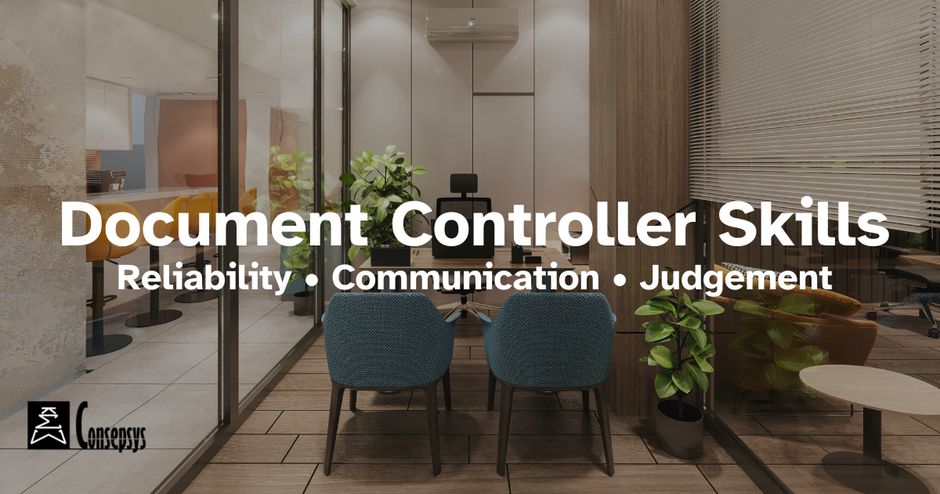
A good Document Controller must be able to control information reliably, support users effectively, and protect the integrity of the document control process.
- Reliability: accuracy, consistency, traceability and revision control.
- Communication: the ability to guide, chase, clarify and escalate professionally.
- Judgement: understanding when speed, pressure or shortcuts may create risk.
1. Accuracy and attention to detail
Accuracy is one of the most obvious Document Controller skills, but it is also one of the most underestimated.
A Document Controller works with document numbers, revision codes, titles, statuses, dates, metadata, transmittals, distribution lists and approval workflows. A small error can create confusion very quickly.
For example:
- the wrong revision may be issued to a contractor;
- an obsolete drawing may remain available in the system;
- a document may be sent to the wrong distribution list;
- an approval status may be recorded incorrectly;
- a document may be filed in a way that makes it difficult to retrieve later.
Employers expect Document Controllers to work carefully and consistently, even under pressure. This does not mean that mistakes never happen. It means that the person understands the importance of checking, verifying and following the agreed process.
Good Document Control is built on reliability.
2. Understanding the document lifecycle
A strong Document Controller understands all the aspects of the existence of a document and what each aspect entails.
A document may be created, reviewed, commented on, updated, approved, issued, superseded, archived or withdrawn. Each stage has a purpose, and each stage must be controlled.
Employers expect Document Controllers to understand questions such as:
- Who is responsible for preparing the document?
- Who must review or approve it?
- What status should it have?
- Which revision is current?
- Who needs to receive it?
- What evidence must be kept?
- What happens when the document is superseded?
This is where the role becomes more than administrative support. The Document Controller helps the organisation maintain control over information that may affect design, construction, operations, compliance, safety, contractual obligations or decision-making.
A person may learn the software quickly. Understanding all the aspects of the existence of a document and what each aspect entails usually takes more structured learning and experience.
3. Organisation and consistency
Document Control requires a high level of organisation, but not only in the personal sense of being tidy or well-planned.
Employers expect Document Controllers to organise information in a way that works for the wider team. This includes consistent naming, numbering, filing, metadata, revision control, registers and reporting.
A good Document Controller does not create a system that only they understand. They help maintain a structure that allows authorised users to find the right information, at the right time, with confidence.
Consistency matters because Document Control is a collective discipline. If every person names, stores, revises or issues documents differently, the system becomes unreliable.
The Document Controller is often the person who protects that consistency day after day.
4. Communication skills
Many people imagine Document Control as a quiet back-office role. In reality, it involves constant communication.
Document Controllers interact with authors, users, engineers, project managers, clients, contractors, suppliers, quality teams, construction teams, procurement, operations and sometimes legal or regulatory stakeholders.
They may need to:
- chase overdue reviews;
- explain why a document cannot be issued yet;
- clarify a workflow requirement;
- reject an incorrect submission;
- remind users to follow the agreed procedure;
- help someone find the correct document;
- escalate repeated non-compliance.
This requires tact, clarity and confidence.
Employers do not usually want a Document Controller who simply says “yes” to everything. They need someone who can support the team while protecting the process. That balance is important.
The best Document Controllers are helpful, but they are not passive.
5. Ability to follow procedures — and understand why they exist
Following procedures is central to Document Control. However, employers increasingly expect more than mechanical compliance.
A Document Controller must understand why the procedure exists.
For example, document numbering is not just a formatting preference. It supports identification and retrieval. Revision control is not bureaucracy. It prevents confusion between revisions. Transmittals are not just emails with attachments. They provide evidence of formal issuance.
When a Document Controller understands the purpose behind the rules, they are better able to apply them correctly, explain them to others, and identify when something does not make sense.
This is particularly important on complex projects, where procedures may need to align with client requirements, contractual obligations, quality systems or regulatory expectations.
6. Software competence
Most Document Controllers use an Electronic Document Management System, a Common Data Environment, a shared platform, or a combination of tools.
Employers usually expect a Document Controller to be comfortable with software applications. This may include:
- uploading and registering documents;
- managing metadata;
- routing documents for review or approval;
- issuing documents formally;
- extracting reports;
- maintaining document registers;
- checking audit trails;
- supporting users.
However, software competence must not be confused with Document Control competence.
Knowing which buttons to press is useful, but it is not enough. The Document Controller must also understand what the action means in the process. For example, changing a status, issuing a revision, closing a review cycle or superseding a document may have consequences for the project.
The software is a tool. The discipline behind the tool is Document Control.
7. Awareness of risk
Employers value Document Controllers who understand that poor Document Control creates risk.
The risks may be operational, contractual, financial, regulatory or safety-related. A team working from the wrong document may make the wrong decision. A missing audit trail may weaken the organisation’s position in a dispute. A poorly controlled review process may delay approvals. Incorrect distribution may expose confidential information or leave key stakeholders uninformed.
This does not mean that the Document Controller owns every project risk. It means they must recognise where documentation practices can create problems and must know when to escalate.
A good Document Controller notices patterns:
- repeated late reviews;
- documents submitted with incorrect metadata;
- uncontrolled copies circulating outside the system;
- unclear approval responsibilities;
- inconsistent use of statuses;
- missing evidence of issue;
- users bypassing the agreed workflow.
Employers appreciate Document Controllers who can spot these issues early, because early correction is usually far easier than late recovery.
8. Professional judgement
Document Control involves many rules, but the role still requires judgement.
A Document Controller may need to decide whether a submission is complete enough to be registered, whether a document must be returned to the originator, whether an issue requires escalation, or whether a user needs guidance before making a mistake.
Judgement also matters when dealing with pressure. On projects, people often want documents issued quickly. Speed matters, but uncontrolled speed can create problems.
Employers expect Document Controllers to understand the difference between being responsive and cutting corners.
This is one of the skills that often separates a competent and experienced Document Controller from someone who is simply operating a document management software application.
9. Confidentiality and professional conduct
Document Controllers may handle sensitive information: commercial documents, technical data, contractual correspondence, personal information, security-related documents or information linked to disputes.
Employers therefore expect discretion and professionalism.
This includes understanding access rights, distribution restrictions, confidentiality requirements and the importance of not sharing information casually. It also includes maintaining professional neutrality. A Document Controller may be involved in difficult project situations, but their role is to preserve control, evidence and clarity.
Trust is essential in Document Control.
10. Willingness to learn the work environment
Document Controllers do not need to be engineers, lawyers or project managers. However, they do need to understand the environment in which they work.
A Document Controller in engineering, construction, energy, manufacturing, infrastructure or operations will gradually need to understand the types of documents being controlled, the stakeholders involved, the approval routes, the project phases and the consequences of poor information control.
Employers value Document Controllers who are curious enough to learn the context.
This helps them ask better questions, identify unusual situations, and support the team more effectively.
If you are entering the profession or formalising existing experience, structured training can help you understand the principles behind revision control, document status, workflows, metadata, distribution, traceability and project risk.
Consepsys offers specialist Document Control courses and certification for professionals who want to develop credible, practical and internationally relevant skills.
What this means for candidates
If you are trying to become a Document Controller, it is useful to show employers more than general administrative ability.
Administrative experience can be a very good foundation. Many Document Controllers come from administrative, coordination, project support or office support backgrounds. But employers will want to see that you understand the specific responsibilities of Document Control.
On a CV or during an interview, it helps to demonstrate that you understand:
- all the aspects of the existence of a document and what each aspect entails;
- revision and status control;
- document status or suitability of use;
- the importance of traceability;
- controlled distribution;
- document registers;
- metadata;
- review and approval workflows;
- confidentiality;
- the risks linked to poor document control.
You do not need to know everything before your first role. However, you do need to show that you understand the nature of the discipline and that you are ready to learn it seriously.
What this means for employers
For employers, the main lesson is that Document Control must not be treated as basic administration.
If the role is poorly defined, undertrained or reduced to file uploading or document sharing, the organisation may not get the protection it needs. A Document Controller can only perform effectively if the role has clear responsibilities, a defined procedure, suitable tools, adequate authority and proper training.
Recruiting someone organised and accurate is important. Giving that person the knowledge and framework to perform Document Control properly is just as important.
Final thought
The best Document Controllers combine discipline, accuracy, communication and judgement.
They understand that documents are not just files. They are controlled information, evidence of decisions, records of work performed, and essential inputs into project and organisational activity.
That is why employers increasingly expect Document Controllers to bring more than software skills or administrative experience. They expect a professional approach to information control.
For people entering the profession, this is good news. Document Control is a real career path, with specific skills that can be learned, developed and demonstrated through experience, training and certification.
Document Controller: Tasks & Responsibilities